
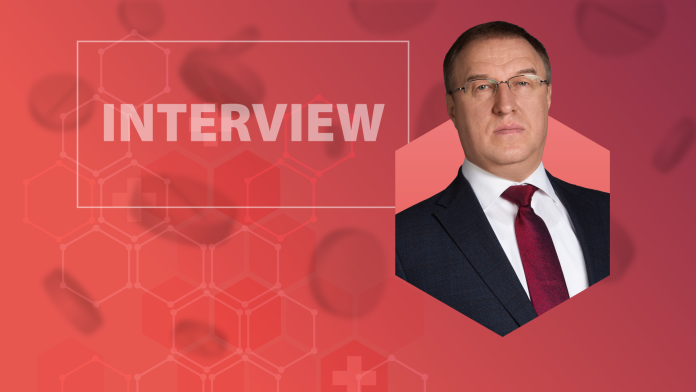
In 2023, the Federal State Institution “State Institute of Drugs and Good Practices” (FSI “SID & GP”) marked its 50th anniversary. The organization is responsible for GMP inspections of pharmaceutical manufacturers and has been led by Vladislav Shestakov for the past 12 years. In an interview with GxP News, he discussed the Institute’s work, its objectives, and prospects.
A Team of Professionals
Twelve years ago, the Institute had only 19 employees with no inspection experience. How did you manage to build a large team of professionals whose expert opinion is now respected not only by the Russian pharmaceutical industry but also by international colleagues?
Today, the modern Russian GMP Inspectorate is a driver of the pharmaceutical industry, an active initiator and participant in key pharmaceutical projects, both Russian and international. The FSI “SID & GP” is an integral part of the Russian GMP Inspectorate, which was established and operates under the Russian Ministry of Industry and Trade to conduct pharmaceutical inspections of Russian and foreign manufacturers for compliance with Good Manufacturing Practice (GMP) rules.
Each of our inspectors not only has actual experience working at active production sites but also never stops acquiring new knowledge to conduct high-quality GMP inspections.
All our employees are well aware of current global production standards, their latest updates, advanced technologies and innovations, changes in the legislation of the Russian Federation and the Eurasian Economic Union regulations, as well as global trends in the pharmaceutical industry.
The first experts at FSI “SID & GP” joined the team in 2014. We had to start building a team, developing expertise, establishing processes, creating an internal quality system for the inspectorate, and setting up training programs for personnel. It was around this time that our experts took their first steps as inspectors. At the end of 2015, a regulatory framework was adopted, allowing FSI “SID & GP” to begin international inspections starting in 2016.
Furthermore, we have been able to implement regular projects such as the International GMP Conference, the industry competitions “GxP-Profi” and “GxP-Fest,” and establish the Eurasian Academy of Good Practices.
What are your criteria for selecting team members?
The most important criterion is professionalism. The second equally important quality is a desire to work—a spark in the eyes. When you sense that a colleague is motivated, eager to work and grow, and not just putting in their hours, you understand that this employee will be effective. Personally, I have great respect for enthusiasm in people. That’s why I select professionals with that sparkle in their eyes for my team.
The first employees who joined us were exactly like that. Many of them had vast practical experience, having worked in the industry for decades in senior positions. One might wonder, why would they change anything, take a risk, leave well-paid jobs? But they were all attracted by the opportunity to be pioneers, to test their mettle, to take on a challenge. I believe this contributed to our success. I managed to assemble a team of people who believe in the achievability of the set goals, and a shared belief in success is a very strong, powerful motivational mechanism. Many of those who joined us in 2013 are still working here today.
Sustainable Development
What have you managed to achieve in recent years?
Generally speaking, the most important achievement has been the creation of a modern Russian GMP Inspectorate, which includes inspectors from the Russian Ministry of Industry and Trade and the FSI “SID & GP,” united to conduct GMP inspections according to their established competencies and making it successful and known worldwide. Our primary task was the launch of its active work, so all our efforts were focused on that. Now, our main goal is to maintain the highest professional level of our experts.
How has the stance of Russian drug manufacturers regarding the need to implement GMP standards changed during this time?
The requirement for mandatory compliance with GMP standards was first legally enshrined in Federal Law No. 61-FZ, so the industry has got used to this idea. Now, most companies realize that they need to change, to keep pace with the evolving regulatory environment to remain competitive not only in Russia but also in the international, including the Eurasian, market. To develop export potential, one must meet the highest international standards. Therefore, companies pay great attention to this, strengthening their teams and engaging experts to continuously improve staff qualifications.
Drug manufacturing is a socially responsible business. Patients and doctors cannot verify the quality of medicines themselves, but they can be confident in the safety and quality of a drug produced in accordance with GMP standards. In a field built on trust in institutions, the responsibility of both the manufacturer and the regulator is paramount. I really like one saying: quality is an ethical concept. An ethical person cannot produce poor-quality products. In the field of drug manufacturing, this is indeed true.
Invaluable Experience
During COVID-19, the GMP inspections were primarily conducted remotely – via video conferencing. How do you assess this experience?
The remote format certainly cannot fully replace an on-site inspection. But during the pandemic, it became the solution that helped us out of a stalemate. During COVID-19, on-site inspections came to a halt, but the inspection process itself could not be paused, as it was crucial for drug safety and ensuring the population’s supply of medicines.
Conducting inspections via video conferencing served as a way out of this difficult situation. However, remote inspections require greater professionalism, attentiveness, and a much deeper immersion in the subject matter. Our inspectors, drawing on their extensive competencies, handled this excellently.
It is not surprising that our colleagues from the Eurasian Economic Union countries later began to use our experience, as we were among the first to apply this inspection format. Even when ISPE organized conferences on remote inspections, they consistently invited us as experts as by that time we already had invaluable experience in this area.
How important is it for the Russian GMP Inspectorate and the industry to continue developing international cooperation with friendly countries? In which areas could such cooperation be most productive?
We cannot exist in a vacuum. Any interaction on the international stage is a mutual exchange, an opportunity to acquire best practices that can then be implemented and adapted to our own realities. Furthermore, it is a chance to share our experience with colleagues. International cooperation in our field enhances the country’s reputation. Foreign partners must see that our regulatory system is second to none in the world. Yes, it is complex, but that is its strength. It is very pleasant, even flattering, that many international colleagues, when we explain our regulatory system, see its effectiveness, and use it as a basis for their own countries.
In addition, cooperation with foreign colleagues is an opportunity for the professional growth of the Russian GMP Inspectorate’s employees. Through joint audits and training inspections, they gain invaluable experience.
And most importantly, international cooperation builds trust in the manufacturing country. You must agree, it is very difficult to earn trust even within one’s own country. An enormous amount of work is required to convince a manufacturer from another country to trust a Russian manufacturer. First and foremost, we must demonstrate that all risks to quality and safety are minimized during production and that there is complete control at all stages of drug manufacturing. This is the regulator’s task. That is how trust in the product, the manufacturer, and the country is built.
Therefore, it is extremely important for the regulator to have a high status, which is achieved through cooperation with foreign partners. The regulator’s effective work in this area contributes to the development of our country’s export potential.