




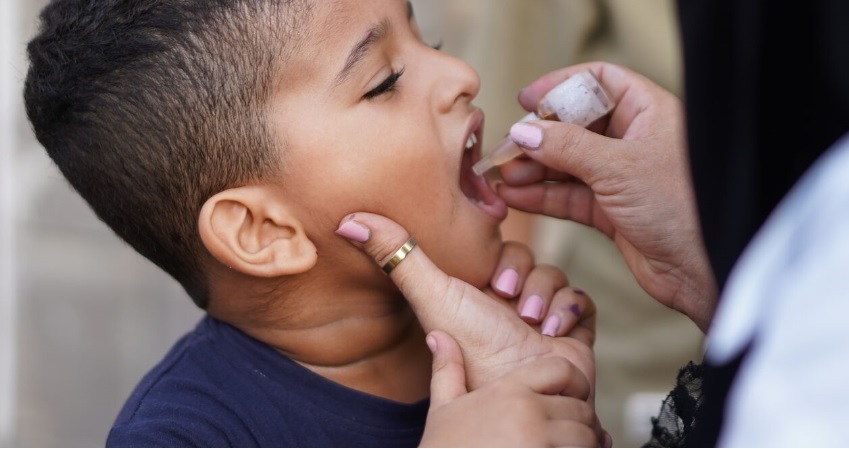
The World Health Organization (WHO) has granted prequalification to another novel oral polio vaccine type 2 (nOPV2). This prequalification certifies that the vaccine meets international standards for quality, safety, and efficacy, enabling UN agencies, including UNICEF, to procure and distribute it for immunization campaigns.
The vaccine is manufactured by India’s Biological E. Limited using technology from Indonesia’s PT Bio Farma. Compared to traditional monovalent oral polio vaccines, nOPV2 is designed to be more genetically stable, lowering the risk of triggering new outbreaks while helping to stop transmission.
According to the WHO, progress in vaccine development and timely supply continues to yield results. For instance, last year 41 cases of wild poliovirus were reported in 24 districts of Pakistan and Afghanistan, compared to 99 cases in 49 districts in 2024.
The nOPV2 vaccine is indicated for active immunization of all age groups during outbreaks of type 2 poliovirus—one of the three serotypes of the pathogen that attacks the grey matter of the spinal cord and causes irreversible paralysis.
Although the wild strain was officially declared eradicated over a decade ago, the virus remains a threat due to the phenomenon of circulating vaccine-derived poliovirus (cVDPV). The issue is that in communities with low vaccination rates, the type 2 strain, when transmitted from person to person, can undergo genetic reversion—regaining its neurovirulence and contagiousness—effectively becoming analogous to the wild virus.
Vaccines like nOPV2 contain a genetically modified version of the strain, designed to eliminate the possibility of reverting back into a dangerous, transmissible form.