



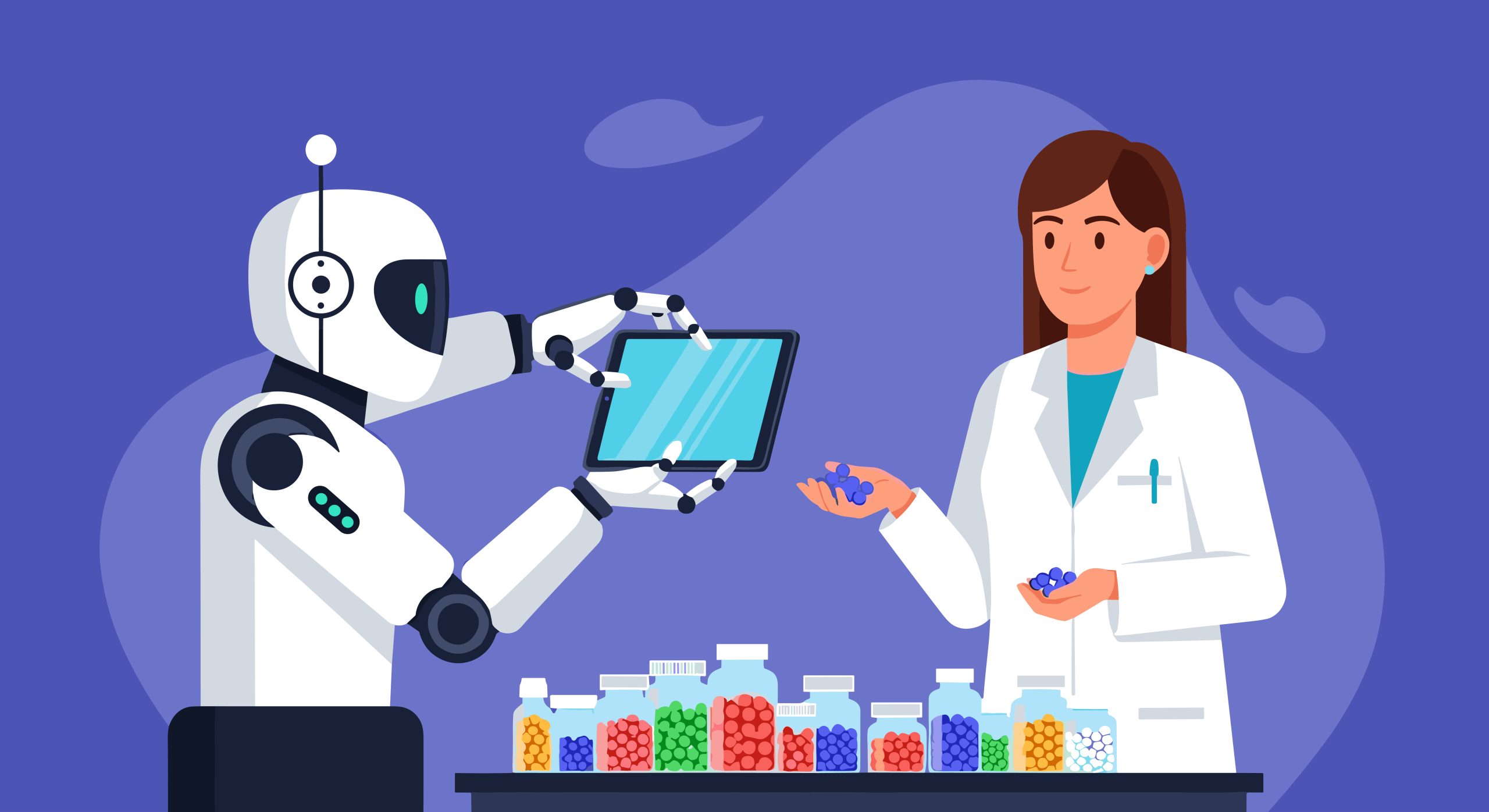
Despite billions in investments by pharmaceutical companies in artificial intelligence, no drug developed with its help exists yet. Artificial intelligence still cannot handle the most challenging task in drug development — the discovery of new molecules. However, it is already simplifying routine parts of this process, say representatives of major companies.
Over the past five years, venture capital investments in AI projects in the field of drug discovery amounted to about $14 billion, with $6.7 billion in 2024 alone after a period of stagnation. AI helps select participants and research centers for clinical trials and prepares documents for regulators, significantly shortening these processes, as noted by representatives of large international pharmaceutical companies and small biotech firms at the recent JP Morgan Healthcare Conference.
Pharmaceutical companies have announced a slew of deals for tools to unleash the promise of AI. According to a 2025 forecast by consulting firm McKinsey, autonomous AI requiring minimal human intervention could increase clinical development productivity by about 35–45% over the next five years.
Executives from AstraZeneca, Pfizer, as well as small biotechnology companies, say they use AI to process thousands of pages of documents for regulators. The documents must be compiled, cross-checked, and kept consistent across regions, often requiring the costly use of outside contractors, explained AstraZeneca Chief Financial Officer Aradhana Sarin. Roche acquired platforms for collecting and processing real-world clinical data in oncology — the American company Flatiron Health — for $1.9 billion in 2018.
Jorge Conde, a general partner at venture firm Andreessen Horowitz, invested $4.3 million in the startup Alleviate Health. He currently describes trial enrollment as a “leaky funnel” where participants frequently drop out. Alleviate will use AI technologies for patient outreach, education, screening, and appointment scheduling.
TD Cowen analyst Brendan Smith says that the Copilot program, which handles administrative tasks, is actively used in the pharmaceutical industry. However, he notes that it may take investors another one to three years before they can assess how much AI is speeding up drug development. Quantifying savings is difficult, Smith noted, as it depends on how and where these tools are used.
Novartis began using AI in 2023 when the company started a clinical trial for its cholesterol drug Leqvio with 14,000 participants, said the company’s Chief Medical Officer Shreeram Aradhye. According to him, the process of selecting trial sites, which previously took four to six weeks, turned into a two-hour meeting: AI helped identify the most effective sites and allowed the company to complete participant enrollment. A Novartis spokesperson said the time savings provided by AI could add up to several months.
Since 2025, Novartis has been collaborating with the UK-based Relation Therapeutics to understand disease biology. Relation Therapeutics uses machine learning and biomedical data arrays to identify causal relationships in immunology and dermatology. The Swiss pharmaceutical company paid $55 million as an upfront payment, equity investment, and R&D funding. In addition to this upfront payment, Relation could receive up to $1.7 billion in milestone payments, as well as royalties on net sales of any products that reach the market.
British GSK stated that it uses a combination of digital tools and AI to reduce manual data collection and processing, as well as patient enrollment in clinical trials, and aims to speed them up by 15% this way. According to a GSK spokesperson, this already helped save about £8 million ($10.87 million) in the late-stage studies of the asthma drug Exdensur last year. The drug received approval in the U.S. in December 2025.
The Danish company Genmab, which specializes in creating differentiated antibodies for treating cancer and other diseases, announced plans to use the developed chatbot Claude to automate work after completing clinical trials, including data analysis and its conversion into clinical study reports. German ITM, engaged in the production of radiopharmaceuticals, developed a way to use AI to convert lengthy clinical trial reports into FDA-compliant formats, which could save weeks of work requiring several employees, but has not yet implemented this technology.