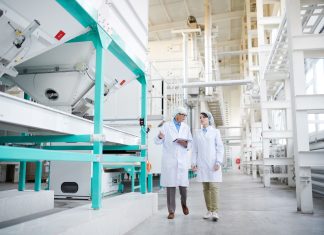

The Pharmstandart group invested more than 30 billion roubles ($320 million) in production, warehouse capacity and R&D between 2021 and 2025, company representatives told GxP News. The company plans to invest at least another 20 billion roubles in capacity expansion in the near future.
As part of the investment plan, construction of an administrative‑production complex with over 25,000 square metres of space has been completed this year at the Pharmstandart-UfaVITA plant in the Republic of Bashkortostan. The company expects to put the building into operation shortly.
The new facility will double the plant’s capacity for drugs in plastic ampoules produced using blow-fill-seal (BFS) technology. It will also double lyophilised drug production and accommodate new lines for suppositories and hormonal eye drops.
Pharmstandart-Leksredstva plant in Kursk, commissioned large-scale solid dosage form production line – manufacturing painkillers, cardiovascular and ENT drugs – was in 2023. In 2024, a soft gelatin capsule workshop was launched at the same site, along with production of non-steroidal anti-inflammatory drugs and vitamins.
Since February 2025, the company has been building a new facility at the same plant to produce hormonal drugs in tablets, soft gelatin capsules, gels and creams. The project is scheduled for completion in October 2026.
In the Vladimir region, Pharmstandart completed construction of a new production facility for ophthalmological drugs and cephalosporin antibiotics at the end of 2025. This has increased output of ophthalmic drugs by 70% and antibiotics by 35%.
Previously, the plant had brought online a new warehouse of more than 8,000 square metres, as well as a laboratory building housing microbiological and quality control laboratories. The production of solutions, including injectables, has also been modernised.
Another large-scale production upgrade has been carried out at the Daliompharma site in Belarus. Pharmstandart owns a 70% stake in the company, which specialises in human plasma-derived drugs such as normal human immunoglobulin and human albumin.
Under the modernisation project, the analytical laboratory and PCR laboratories have been rebuilt, and a new microbiology laboratory has been constructed. The plant’s plasma processing capacity has been increased to 300 tonnes of blood plasma per year.